
Apple Disrupts Laptop Market With MacBook Neo
| By Elaine Zheng |
Strategy, Competition, and What It Signals for the Laptop Market
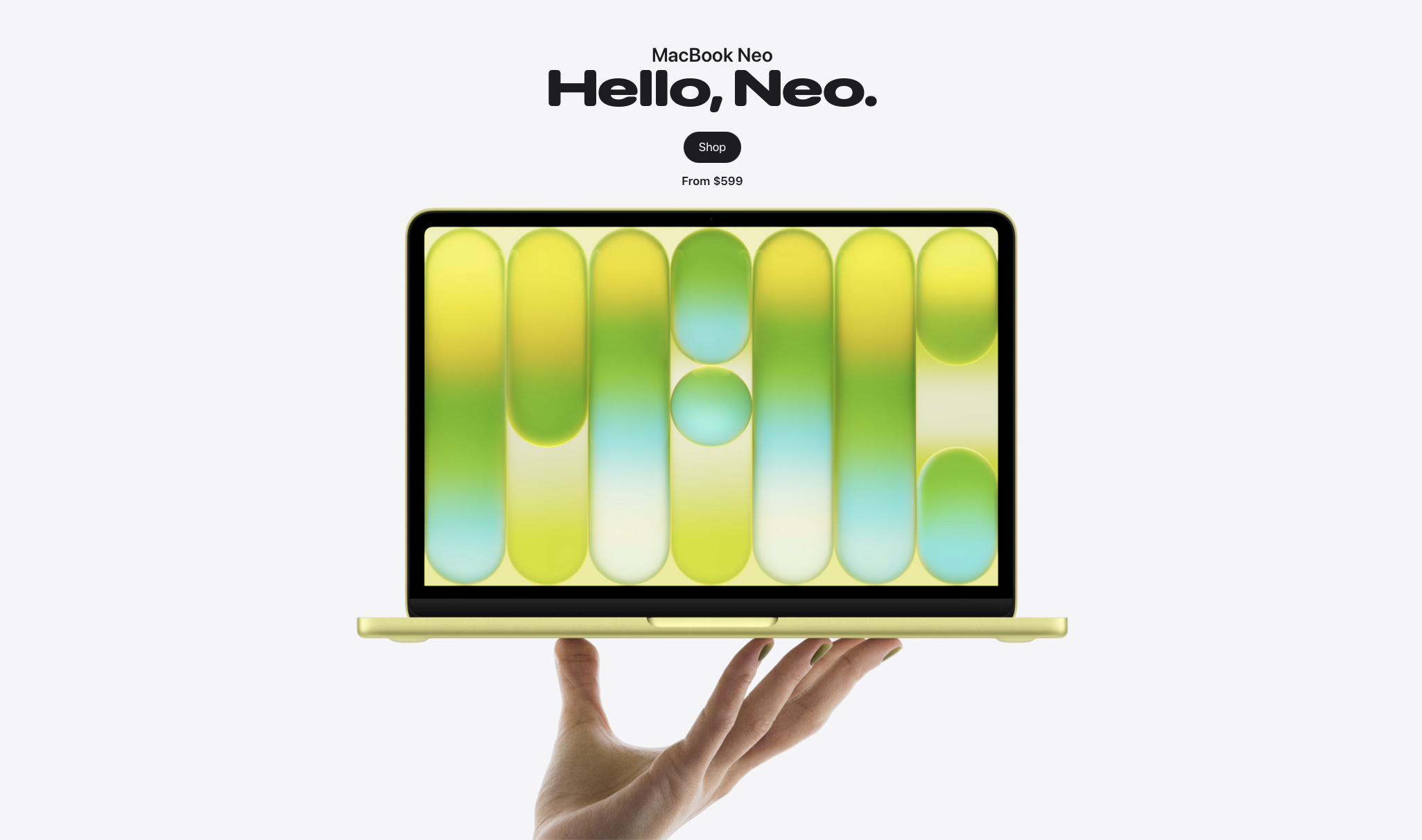
In March 2026, Apple launched the MacBook Neo, shocking the market. The first surprising feature is its price. Starting at only $599, $499 for education customers, this laptop became the cheapest Mac notebook version in Apple’s history. Moreover, it not only redefined Apple’s product lineup but also directly challenged the Chromebook and low-end Windows laptop markets. Three core elements are key to understanding Apple’s strategy behind the MacBook Neo: the background and innovative market positioning of its launch; its impact on the competitive laptop market, particularly the entry-level premium segment; and the deeper implications for Apple’s overall pricing strategy, profit margins, and supply chain management.
Why Apple introduced the MacBook Neo and what is new about its positioning
Apple launched the MacBook Neo officially on March 4, 2026, and began shipping on March 11th. As Apple stated in its official press release, “MacBook Neo delivers the magic of the Mac experience at a breakthrough price, making it even more accessible to millions of people around the world.” This represents the first time Apple has offered a Mac with a starting price under $1,000, marking a major shift in its market strategy.
The most striking aspect of this product is its chip selection strategy. The MacBook Neo is powered by the A18 Pro chip. Rather than being designed specifically for the Mac, it repurposes substandard chips generated during the iPhone 16 Pro production process through yield screening, with the GPU core count reduced from six to five. As Macworld pointed out, “The MacBook Neo uses binned A18 Pro chips — processors originally intended for the iPhone 16 Pro but repurposed due to minor defects that prevent use in phones.” By turning those discontinued chips into core components, Apple significantly decreases production costs.
Further, it is the first time the Mac product line uses A series processors instead of M series processors. This decision demonstrates Apple’s resource reallocation strategy, as well as its expanded production strategy to include more affordable products.
In terms of design, the MacBook Neo has eliminated the notch seen on the MacBook Air, becoming the first non-notch screen MacBook series since 2022. Furthermore, according to iFixit’s teardown report, the MacBook Neo is the most serviceable laptop in 14 years. With its removable battery tray, screw-mounted keyboard, and modular ports, maintenance costs are decreased, sending a positive signal to advocates of the “right to repair” movement.
How may it affect competition in the laptop market, especially in the entry-level premium segment?
The launch of the MacBook Neo has caused significant impact in the laptop market. As Gulf News reported, “Analysts see the MacBook Neo as a direct assault on Chromebooks and low-end Windows machines, potentially capturing 20-30% more market share in education and emerging markets.” The logic here is that the Neo’s largest advantage is its price point, offering similar pricing to Chromebooks while providing more advanced functions. This competitive pressure forces Google and Microsoft to either innovate or decrease prices to remain competitive.
In terms of perceived value, the Neo also differentiates itself from other products. Analytics Insight observed that consumers increasingly consider products’ sustainability rather than simply focusing on low-price options. The Neo’s sleek aluminum body offers a more premium feel compared to plastic Chromebook designs, thus making it more appealing to consumers. By shifting the comparison criteria from price alone to a comprehensive user experience, Apple successfully leverages its brand premium power.
However, the Neo’s competition does have its limits. Kavout’s market analysis noted that the Neo lacks many features found in high-end Macs. Additionally, its non-upgradable 8GB storage may pose issues for power users who rely heavily on storage capacity. As a result, the Macbook Neo primarily targets first-time Mac buyers, such as students and those wishing to switch to macOS with minimal effort.
What it could mean for pricing, margins, and broader hardware supply chain strategy
The MacBook Neo’s competitive pricing results from a highly sophisticated yet risky supply chain strategy. Apple Insider explains that while the chip for the Neo appears standard, it actually lacks one GPU core. These “screened” chips would otherwise be discarded, costing Apple nothing extra. This key factor allows the Neo to be sold at such a competitive price of $599.
However, storage capacity for this chip type is limited, and consumption rates far exceeded initial projections. Moreover, 9to5Mac reported that Apple originally planned to manufacture about 6 million Neo units to utilize its inventory of A18 Pro chips, but the Neo’s sales success now presents a fresh challenge. To continue production, Apple must either design an entirely new chip or modify existing ones, but the Taiwan Semiconductor Manufacturing Company (TSMC)‘s current 3nm production capacity is heavily occupied by AI customers, constraining Apple’s strategic options. Another possibility involves altering the pricing strategy for the Mac mini by discontinuing the 256GB version and focusing on the more profitable 512GB configuration.
From a long-term perspective, Apple has already initiated plans for a second-generation MacBook Neo. MacRumors reveals that “the new MacBook Neo will be equipped with a version of the A19 Pro chip from the iPhone 17 Pro models, featuring an increased 12GB of RAM.” This signals that Apple has integrated the reuse of chip die into its standard product line planning, rather than treating it as a one-off approach.
A New Benchmark in the High-End Laptop Market
The MacBook Neo represents more than just a new Apple product. It showcases how a technology company can innovate to redefine value margins. By combining an iPhone-grade chip, an aluminum body, and the macOS ecosystem at a $598 price point, Apple has achieved a significant market breakthrough.
In this market landscape, winners include first-time Mac buyers, the education sector, and the broader macOS ecosystem, as the Neo introduces many new users. However, Chromebook manufacturers and mid-to-low-end Windows laptop brands face notable challenges. Additionally, Apple must reevaluate its own profit margin strategies due to the chip sourcing.
For the entire premium laptop market, the MacBook Neo signals a shift in how price barriers are defined, blurring the line between brand premium and value for money. Amid rising global component costs and widespread price increases by competitors, Apple’s ability to defy trends and launch a high-quality, low-cost product is both a testament to its competitive edge and an innovation in supply chain management. This case may serve as a crucial reference point for future research into hardware strategy.
Featured Image is ©Apple