
The EU–India Trade Deal: Winners, Losers, and What It Means for Global Supply Chains

| By Elaine Zheng |
In recent years, global trade has entered a period of major restructuring. Three key facts define this shift: rising geopolitical risk, the regionalization of supply chains, and stricter carbon compliance regulations. Against this backdrop, the Free Trade Agreement between the European Union and India marks a pivotal moment in the current global trade landscape. It will not only affect EU-India trade directly but also reshape global supply chain configurations, competitive dynamics in key industries, and corporate compliance costs.
This article explores three core dimensions: the agreement’s key changes, its impact on industries and trade flows, and practical responses for businesses managing procurement, costs, and compliance.
New Changes in the Agreement: From Tariff Reductions to Rule Certainty
The core meaning of this FTA between the EU and India is not simply about tariff decreases from a traditional perspective; it is more about providing stable and predictable investment and trade rules. As the Wall Street Journal noted, this agreement will enormously increase market access and trade facilitation in both areas, as well as strengthen economic relationships in manufacturing and consumer goods.
For businesses, rule certainty is more important than tariff reductions. When firms operate supply chains, they require clear rules of origin, certification processes, and long-term, stable market access conditions. The push of this agreement means firms become more confident in building production bases in India, expanding exports, and reconstructing supply chains, in order to shift from policy uncertainty to “calculable costs.” Moreover, according to DLA Piper, multiple U.S. law firms have analyzed that such large-scale FTAs typically involve benefits such as simplified trading procedures, enhanced investment protections, and gradual regulatory adjustments. As a result, these changes will directly impact corporate investment and procurement decisions.

Industry Impact and Trade Shifts: Competitive Effects
The automotive sector is predicted to be one of the biggest beneficiaries of the FTA. With improved market access and reduced tariffs, European car brands’ price competitiveness is predicted to increase in the Indian market, which will boost vehicle sales and drive expansion across supply chains for parts, delivery, and after-sales service networks. For the global supply chain, this means European car industries may increase assembly and parts procurement in India, and Indian parts industries may have opportunities to enter Europe. However, other exporting countries (such as certain Southeast Asian production bases) may face order diversion. An article in the Wall Street Journal explained that trade agreements often cause supply chain repositioning, and firms will reevaluate optimal combinations of production locations and sales markets.
Labor-intensive sectors such as textiles are particularly sensitive to tariff reductions and rules of origin. The U.S. Legal and Trade Advisory Agency noted that supply chain adjustments brought by FTAs often concentrate in labor-intensive sectors like textiles because the industry highly relies on tariffs and rules of origin. If the EU decreases tariffs on textiles from India, some orders destined for the European market may shift from other exporting countries toward India. This may enhance Indian textile export competitiveness, while traditional suppliers may face order losses and European brands may restructure procurement strategies.
Spirits represent another tariff-sensitive sector. They belong to high-tariff products. If tariffs decrease, European spirits would become more competitive in India’s retail market, leading to large market expansion. This could result in European spirits companies expanding their market presence in India, increased local bottling and distribution partnerships, and accelerated brand marketing and channel development. From a trade perspective, this change would not only impact corporate revenue structures but could also alter global production and distribution strategies.

Practical Implications at the Enterprise Level: Costs, Procurement, and Compliance
Tariff reductions directly affect landed costs, requiring firms to reevaluate pricing strategies, channel profit margins, and the economics of exports versus local production. Companies typically need to rebuild cost models to determine whether shifting portions of production into new trade agreement regions becomes advantageous.
As EU–India trade relations strengthen, India may assume a more significant role in “China+1” or diversified supply chain strategies. Firms may increase procurement and production in India, establish regional distribution centers, and adjust inventory levels and transportation routes.
Despite the tariff reductions, industries must navigate complex trade requirements, including certificates of origin, product certification, labeling, customs declarations, and audit records. Failure to meet these requirements can disqualify firms from FTA tariff benefits.
Even as the EU–India trade agreement improves the tariff landscape, the EU Carbon Border Adjustment Mechanism (CBAM) may still impact exporters. CBAM aims to impose additional costs on high-carbon-emission products to prevent “carbon leakage.” As the Peterson Institute for International Economics noted, CBAM may alter export strategies, as carbon emission costs become a new variable in trade calculations. Additionally, the U.S. think tank CSIS emphasizes that carbon border mechanisms will reshape the international trade landscape and push industries toward low-carbon production.
Conclusion: A New Case Study in Supply Chain Reshaping
The EU–India Free Trade Agreement is more than a bilateral deal. It signals a broader international supply chain reconstruction. Winners include European automotive and spirits firms and Indian manufacturing and textile exporters. Challenges arise from intensified competition due to trade diversion, rising compliance and carbon costs, and difficulties executing supply chain reconfiguration.
For firms, the critical question isn’t whether an FTA exists, but whether they can swiftly adjust cost models, supply chains, and compliance structures to capture opportunities in this new trading environment. As international trade enters the “rules + carbon costs” era, this agreement offers crucial evidence for future supply chain strategic adjustments.
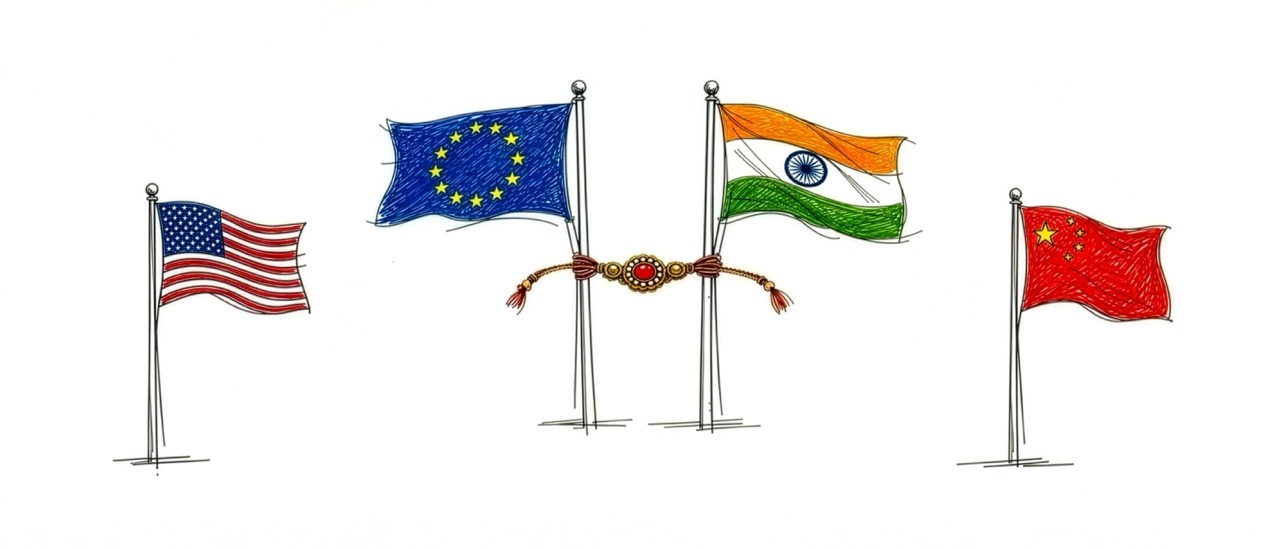
The images in this article were created using an AI image generator. All illustrations are ©Intelliwings.