Reformulating Education and Employment in the Post-AI Bubble

| By Barry Yao |
Graduates Facing Economic Uncertainty
Today’s college graduates are some of the most well-educated people in history. Yet, despite their credentials, they face an enigmatic economic landscape. These young people are entering a workforce still reeling from the COVID-19 pandemic shock, while facing an AI technological revolution as transformative as the previous industrial revolution. Unemployment, which 1 in 10 graduates will face, mirrors the 2008 Global Financial Crisis, when youth unemployment increased and forever altered young people’s careers. However, viewing today’s unemployment problem in the same light as 2008 would be a grave mistake that misunderstands the troubles young people face in 2025. Nevertheless, it is important to revisit the 2008 crisis’s impact on youth unemployment.
First Fired, Last Hired: The 2008 Crisis and the Disadvantages of Entry-Level Roles
The 2008 crisis was not just a typical economic downturn. It was a systemic rupture for youths about to enter the workforce. The financial crisis created a “scarred generation” whose lives were fundamentally altered. As the crisis unfolded from the collapse of the housing market, deeply rooted in Wall Street’s financial system, it spread globally—credits froze and economies worldwide contracted at a pace not seen since the 1930s Great Depression. The effect on the job market was mass layoffs, hiring freezes, and the stoppage of business investments. Young people, typically the first fired and last hired due to lack of experience, found themselves competing on a playing field that was shrinking. Of course, the consequences extended far beyond the crisis year.
The scarred labor market had long-term implications. Research conducted by the University of Notre Dame shows that the wages of students graduating during the Recession years are 5 to 15 percent lower than they would have been in non-recession years. Low wages and lack of job opportunities pushed many students away from “traditional” pathways in finance and business into the informal sector, where wages are lower, benefits are fewer, and stability is less likely. Students who miss early-career opportunities are not just missing employment; they are also missing out on crucial skill development, promotions, and time to establish a professional portfolio. The period of unemployment also erodes graduates’ human capital, the economic value of a worker’s experience and skills, and networks, creating a gap that systemically disadvantages them compared to peers who may graduate in a healthier market.
Graduate School as Economic Refuge
Perhaps the most telling statistic of graduates’ confidence in the job market is graduate school application numbers. Applications spiked immediately after 2008, seen as a direct response to the dire job market conditions. Instead of viewing universities as places of study and advancement, graduates saw graduate programs as a safe harbor where they could shelter from economic realities. Attending graduate school also allowed students to enhance their qualifications and differentiate themselves from other job applicants. Consequently, applications to law schools, business schools, and other graduate programs increased.
This “flight to school” phenomenon was driven not by graduates’ thirst for knowledge, but by fear of their vulnerability in the outside world. While universities were once places to acquire critical job-related skills, students discovered their degrees meant little when facing historic macroeconomic headwinds. Furthermore, increased graduate school applications meant fiercer competition, and programs became more selective. For many students, the only feasible choice to avoid the long-term scarring effect of unemployment was substituting their lack of experience with a prestigious degree, hoping employers would eventually hire them.
The Economics of Credential Escalation
In closer analysis, a surge in graduate school applications is a counter-cyclical indicator of a weak job market. This inverse relationship represents a cost-benefit calculation. In a strong job market with powerful economic tailwinds, the opportunity cost of attending graduate school is high because students are compelled to start their careers where employment becomes a more attractive path. However, in a weak job market, the opportunity cost of continuing education is low because the alternative is often underemployment or unemployment. This trend is further exacerbated by the need to differentiate oneself from other candidates in a tight labor market. When entry-level positions, which usually require only bachelor’s degrees, suddenly receive hundreds of applications, that same degree becomes insufficient. Pursuing a master’s or other advanced diploma becomes a strategic move to “stand out.” At the same time, if all applicants view their credentials as insufficient and choose to pursue advanced degrees, the extra margin of product in the value of their new degree also becomes minimal. In other words, if all candidates receive master’s degrees, they will also face the same situation when they graduate, having only shifted the competitive bottleneck to a higher level. Under these circumstances, the master’s degree becomes the new bachelor’s, and the cycle of degree inflation continues.

AI’s Economic Dominance: Boom or Bubble?
Just as the students from the 2008 Global Financial Crisis, the class of 2026 could very well become the next lost generation. Today, the tech world is abuzz with artificial intelligence. Venture capital investments are pouring into AI companies, and major corporations are integrating AI to increase productivity and minimize cost. Reports have shown that data centers, the physical infrastructure of this new digital economy, powered most of the United States’ GDP growth in 2025. Although the technology sector only represents 4% of the country’s economy, it contributed 92% of its growth. Without tech investments, the United States’ economy would have stagnated. These statistics carry the hallmarks of a speculative bubble that, if it bursts, could unleash severe youth unemployment, similar to 2008’s.
During the boom, hiring for roles in AI, data analytics, and sales surged. If the bubble bursts, the first direct impact is a sharp contraction of the tech sector itself, which has employed many young talents in recent years. Tech giants Nvidia, Meta, and Microsoft would face immediate downward investor pressure to initiate layoffs. The “last in, first out” principle will prevail, and an entire generation of graduates will see their career pathways vanish before their eyes, leaving them with specialized skills no longer in demand.
Automation’s Impact on Career Ladders
The collapse of the tech sector would signal the bursting of the bubble, but the lasting crisis would bring structural changes to the economy. Unlike the 2008 GFC, where the crisis stemmed from the finance industry, the AI bubble burst will be centered on a productivity-inducing product. As a result, companies across all sectors would be under immense pressure not only to cut costs, but to operate more efficiently. In this scenario, the most automated and efficient companies will survive, where AI would reduce the size of their workforce. Indubitably, the roles most vulnerable to this structural shift are precisely entry-level positions that engage in repetitive, process-oriented tasks. These jobs, traditionally reserved for young graduates and that allowed them to build a solid foundation, will slowly be replaced by a more productive, efficient model.
One cannot view entry-level positions simply as jobs; they are the training grounds where young professionals learn industry-specific skills, improve their networks, and build professional experience. By automating this important first step in the career process, companies would inadvertently narrow graduates’ paths to transition from education into stable employment, and could even keep many highly qualified graduates out of the workforce. Additionally, the organizational structure of companies will change. Typically, companies are structured in a triangle, with executives at the top and junior workers at the bottom. This structure allows advancements from lower-level workers into middle management, as the most qualified candidates are promoted, while the less qualified either remain in place or are pushed out. However, due to AI and the ever-diminishing number of junior positions, companies’ org charts will resemble a rhombus: narrow both at the top and bottom. Under this structure, the size of the company shrinks over time, because promoted junior workers cannot replace previous middle managers in quantity. This vacuum in middle management will extend to the executives, causing a critical absence in the company’s decision-making body.

The Generational Imperative to Reengineer Work
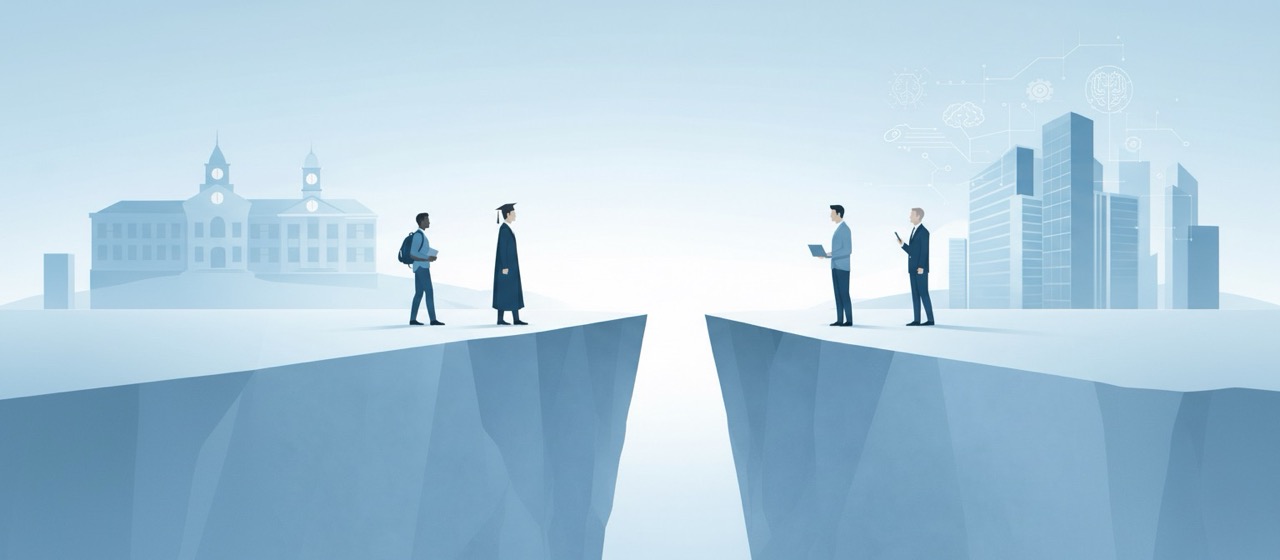
In 2025, students are making the classic recession move again: going to graduate school. The class of 2026 stands at a critical juncture, facing a potential crisis that mirrors 2008 in its capacity to scar a generation—yet the upcoming challenge differs fundamentally. The Global Financial Crisis was defined by a lack of jobs, opportunities, and demand. The incoming AI bubble burst will be characterized by displacement and structural shrinking. The Great Recession froze people’s career paths; the AI-driven downturn would remove roads entirely, not through a lack of economic activity, but through a reformulation of work itself.
The lesson of 2008 was that a generation realized a degree was not a ‘golden ticket.’ The legacy of the AI bubble burst could be that a generation discovers their education, which they went into debt to afford, has lesser practical application in an automated economy. The challenge for business leaders is not to delay the bubble from popping, but to reengineer the definition of work: construct more paths to work, provide more learning opportunities, and ensure the potential of a generation does not become the victim of pursuing greater efficiency. One thing is certain: without youth-supporting policies, tomorrow’s leaders will be left futureless.

The images in this article were created using an AI image generator. All illustrations are ©Intelliwings.