| By Olivia Ernst |
India’s Balancing Act
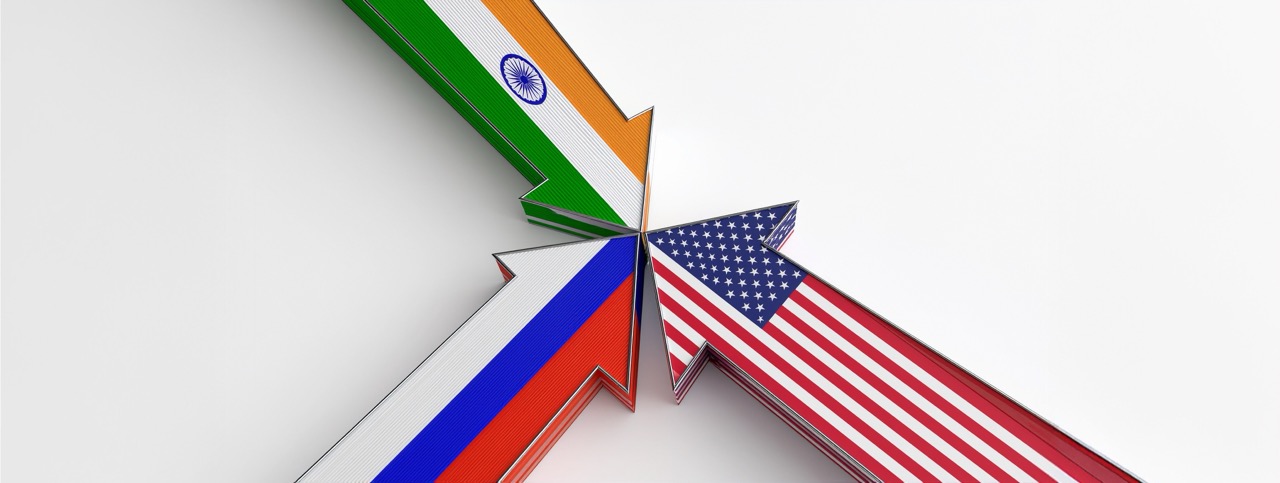
Since Russia’s 2014 invasion of Crimea, India has striven to maintain a balancing act between Russia and the US. While the US has pressured India to condemn Russia for its invasion, India has remained neutral and has maintained steady economic relations with both parties for years. However, India’s days of strategic autonomy may be over as the US doubled its tariffs to 50% on imports from India in an effort to pressure India into cutting its energy ties with Russia. A White House trade advisor told Bloomberg Television that India could have the additional 25% reduced “if it stops buying Russian oil and helping to feed [Russia’s] war machine.” After failed trade talks to reduce the tariffs on imports from India, the country now faces a choice between maintaining strong trade relations with the US or buying cheaper oil from Russia, and it has chosen the latter. In a statement to reporters, India’s Minister of State for External Affairs, Kirti Vardham Singh, emphasized the importance of India’s energy security and that India plans on buying energy from whichever country benefits it. This decision will severely damage India’s export economy, begging for a deeper analysis of India’s dilemma.
Understanding India’s Response
From an economic perspective, the damage of Prime Minister Narendra Modi’s decision to continue purchasing Russian oil is arguably much more severe than appeasing US President Donald Trump. For example, Clyde Russell from Reuters estimated that for India, the upfront cost of Trump’s 50% tariffs pales in comparison to that of replacing Russia’s discounted oil for pricier supplies. Not only is Modi’s decision significantly more expensive, but it is more challenging for India to replace the US as an export market than it is to find crude oil suppliers beyond Russia. While replacing Russia’s crude oil is indeed extremely challenging, replacing U.S. market demand for India’s exports would require much more time and structural change, whereas there are other energy providers to which India could quickly transition, such as those in the EU and the Middle East.
The reasons behind Modi’s decision extend much deeper than discounted crude oil perks. India and Russia share a strong, long-standing relationship that officially dates back to 1947, when India and the Soviet Union first established diplomatic relations. The Soviet Union supported India’s economic self-sufficiency by investing in mining, energy, and steel production. During the Soviet era, Russia backed India on various occasions, most notably during the 1971 Indo-Pakistani War and on several UN Security Council (UNSC) votes between 1957 and 1971. India’s formal trade relationship with Russia began with the 1953 Indo-Soviet Trade Agreement. Since then, their trade relationship has grown, and Russia has emerged as India’s second-largest import source between 2023-2024, constituting 9.10% of India’s total imports. The pair also maintain a longstanding energy partnership that extends beyond crude oil. For example, India and Russia’s nuclear energy collaborations date back to 1985, when the Soviet Union assisted India in developing the Kudnakulam Nuclear Power Plant (KNPP). This relationship has evolved into dependence, as India’s 2010 Civil Liability for Nuclear Damage Act (CLNDA) made nuclear suppliers responsible for any accidents. This increased the cost of insurance for U.S. investors, unlike Russian nuclear energy corporations who could obtain insurance from the Russian Government.
Beyond trade and energy partnerships, India is highly reliant on Russia for defense equipment, sourcing 65% of its purchases from Russia in the last two decades despite recent efforts to diversify its arms suppliers. Beyond defence, maintaining a strong relationship with Russia is crucial for India’s security to prevent Russia from deepening its ties with China, one of Russia’s other main crude oil buyers and India’s rival. Increased Russian dependence on China would pose a massive security threat to India, especially given both countries’ relations with Pakistan, another threat to India. The development of a Sino-Russian nexus would be incredibly threatening to India, even with US support, given their geographic proximity.
India’s Path Forward
Given India and Russia’s historic energy, trade, defense, and security relations, it is unsurprising that India is willing to sacrifice its trade benefits with the US to keep the Kremlin conciliated. Not only does this context provide insight into Modi’s decision, but it also suggests that India is unlikely to budge soon. India has made it clear that it is looking to strengthen ties elsewhere with its recent meetings with China and trade diversification efforts. Unless a future trade deal can be struck with Trump, India’s balancing act between the two may be coming to an end.
The images in this article were created using an AI image generator. All illustrations are ©Intelliwings.