
NATO’s 5% Spending Target and the Future of the Allied Defense Industry

| By Olivia Ernst |
NATO’s 5% Defense Spending Pledge: A New Industrial Imperative
At the 2025 NATO summit in The Hague last month, member nations pledged to invest 5% of their GDP in defense spending by 2035. Building upon the 2% target set in 2014 following Russia’s annexation of Crimea, the new pledge is a response to the increased need for defense as the United States’ role as Europe’s security “guarantor” has become increasingly tenuous amid the ongoing Russo-Ukrainian War. The pledge requires that governments allocate 3.5% of their spending to core defense requirements, based on NATO’s standardized definition, and the remaining 1.5% of spending to indirect defense spending. By generating increased demand for military capabilities, this commitment has the potential to significantly expand the Allied defense industrial base over the next decade.
Impacts on the Allied Defense Industry
The 3.5% spending on core defense requirements is intended to help Allies meet NATO’s new set of capability targets, which focus on expanding military capabilities and the Allied defense industry. This increase stimulates demand and production for military technologies and services. By specifying required forces and capabilities, the targets provide clear, aggregated demand signals to defense contractors, expanding the Allied industrial base’s production capacity. The updated Defense Production Action Plan (DPAP) released encourages joint procurement, further communicating long-term, wide-ranging interest in defense investment to industry partners. These developments are critical for growing Europe’s own defense capabilities, which remain heavily reliant on US-produced military hardware.
The remaining 1.5% for indirect defense spending is loosely defined by NATO as spending to “protect critical infrastructure, defend networks, ensure civil preparedness and resilience, innovate, and strengthen the defense industrial base.” To “defend networks”, governments and contractors must invest more in cybersecurity technologies and services, significantly expanding cybersecurity capabilities across NATO members. This is evident in the recent Cybersecurity Maturity Model Compliance (CMMC) requirements issued by the US Department of Defense (DoD). Since the establishment of the requirement, businesses have demanded more cyber professionals and technologies to meet CMMC standards, resulting in more university courses developed to train individuals to become CMMC assessors. As more countries prioritize complying with the cybersecurity 1.5% requirement, the industry will continue to expand.

Fiscal and Political Hurdles for the 5% Pledge
Though the 5% spending requirement presented at the summit has the potential to significantly expand the Allied defense industrial base, fiscal and political constraints cast doubt on whether these developments will be realized. Many European NATO countries face looming debt burdens that make long-term borrowing unsustainable for funding such increases. Alternative funding, such as raising taxes or modifying government spending, remain politically unattractive without a comprehensive NATO-wide defense strategy to ensure effective use of public resources. Additionally, while NATO defense spending has doubled over the past decade, 2024 reports showed many countries fell short of reaching the 2% guideline pledged in 2014. Thus, while the Allied defense industry may expand over the next decade, the inability of many to meet prior guidelines creates uncertainty about reaching the 5% pledge’s full potential.
Even if NATO reaches the 5% threshold, concerns remain about the defense industry’s capacity to meet demand, particularly in Europe. European defense manufacturers have historically struggled to accommodate rapid increases in demand, leading to quality compromises. Consequently, some experts predict that NATO allies may resort to purchasing ready-for-sale equipment from major US arms producers, limiting the growth of domestic European production capacity.
The extent of the effects on the cybersecurity industry is also uncertain. While 3.5% of the spending has a standardized definition, the other 1.5% remains extremely broad. This portion of the guideline fails to define critical infrastructure, networks, civil preparedness, or the defense industrial base, nor does it clarify what qualifies as spending to protect these national security features. Its vagueness leads many observers to believe allies are already meeting this requirement, as the absence of clear guidelines invites creative accounting. This ultimately calls into question whether this portion of the pledge will drive additional spending on cybersecurity initiatives and thus grow the industry.
Strategic Imperatives Amid American Ambiguities
With improved demand signals through new capability targets and an increased emphasis on indirect defense spending such as cybersecurity, whose ambiguous definitions already invite creative accounting, NATO’s new spending pledge could expand and technologically diversify the allied defense industry. While uncertainty remains over whether members will reach the 5 % guideline and whether Europe’s defense industry can sustain the increased demand without compromising quality or resorting to U.S. procurement, expanding European defense production capabilities becomes increasingly crucial as U.S. military support grows unreliable.
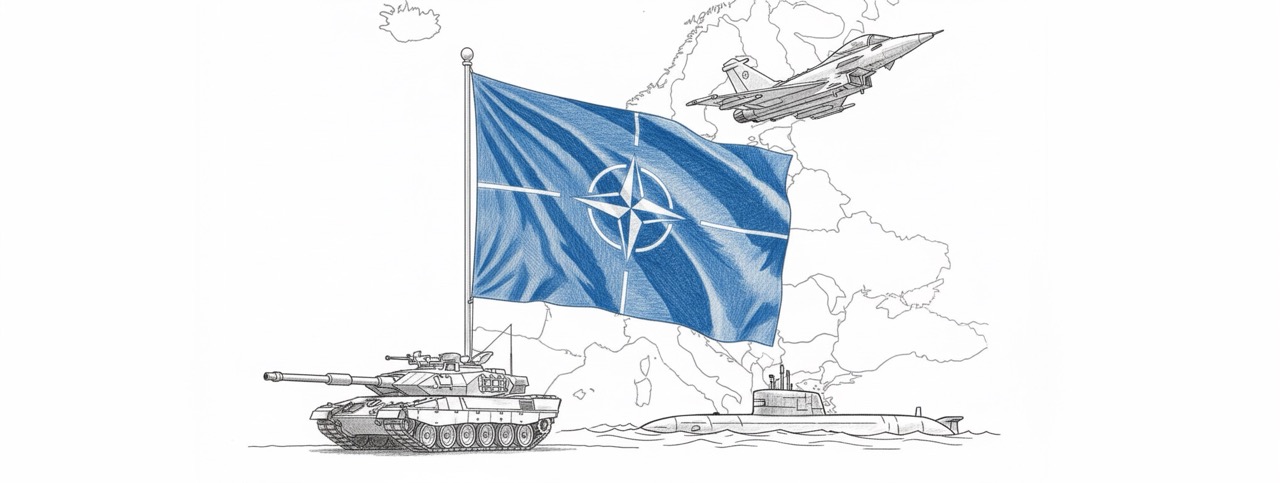
The images in this article were created using an AI image generator. All illustrations are ©Intelliwings.
 Previous post
Gold’s Surge: What’s Behind It?
Previous post
Gold’s Surge: What’s Behind It?
